Mákos guba is a Hungarian bread pudding, usually made of leftover kifli (=crescent-shaped bread) or if you are luckier then from leftover kalács. Though that kind of mákos guba is not quite to my taste, because it has far too little poppy in it. Anyway, I am here with a dessert, that was inspired by the mákos guba. It is a cold version containing poppy parfait, vanilla sauce, sour cherries with port wine and kalács croutons.The whole thing is decorated with crystallized poppy petals.
Ingredients:
for the croutons:
500 g flour
40 g sugar
50 g butter
400 ml milk
15 g fresh yeast
1/2 teaspoon salt
brown sugar
2 tablespoons rapeseed oil
for the poppy parfait:
200 g ground poppy
150 g sugar
2 eggs
200 ml milk
zest of 1 lemon
150 ml cream
for the sour cherry sauce:
150 g pitted sour cherry
2-3 tablespoons sugar
50 ml port wine
1/2 teaspoon cornstarch
1 tablespoons sour cherry juice
for the vanilla sauce:
250 ml milk
1 egg yolk
25 g sugar
1/2 teaspoon flour
1 vanilla pod
Heat
milk until lukewarm. Crumble yeast and sprinkle about a teaspoon of
sugar over it, then pour 100 ml lukewarm milk over it. Mix flour with
salt and the rest of the sugar. Pour yeasty milk into a mold in the
flour and start kneading, while adding the rest of the milk. As soon as
the dough seems to come together and it is almost smooth add lukewarm,
molten butter and knead until smooth. Let it rest in a warm place for
an hour. Braid a bread and put it into a buttered round cake pan and let it raise for another half an hour. Bake for 40-50 minutes over 160°C. Let it cool and slice into cubes. Sprinkle oil and sugar on the crutons and bake for 10-15 minutes or until golden brown over 150°C.
Cook ground poppy in the milk. In the meantime cook a syrup out of the sugar and 60 ml water. Add egg yolks to the cooked poppy among the lemon zest. Beat egg whites with a pinch of salt until almost stiff, then add the 117°C syrup in a thin strain to it while beating constantly. Beat until the egg white is shiny and stiff. Fold it into the poppy base among the beaten cream and freeze for 3-4 hours in any kind of shape you desire.
Bring sour cherry with sugar, port wine to the boil. Dissolve cornstarch in cherry juice and stir it into the sauce. Cook until it thickens.
For the vanilla sauce whisk together the egg yolk with 50 ml milk, sugar and flour. Bring the rest of the milk together with the vanilla pod and seeds to the boil and pour it to the egg yolk mixture while stirring. Pour it back into the saucepan and warm it over low heat until it thinks. Chill for a few hours.
Kalács is a Hungarian sweet bread similar to brioche baked in a braided form and it is typical for Easter, but in our family it may not be missed during Xmas time. Similar braided breads are popular in other Eastern European countries as well. However you do not need any kind of holiday to enjoy this light bread!
Ingredients:
1 kg flour
80 g sugar
100 g butter
800 ml milk
30 g fresh yeast
1 teaspoon salt
Heat milk until lukewarm. Crumble yeast and sprinkle about a teaspoon of sugar over it, then pour 100 ml lukewarm milk over it. Mix flour with salt and the rest of the sugar. Pour yeasty milk into a mold in the flour and start kneading, while adding the rest of the milk. As soon as the dough seems to come together and it is almost smooth add lukewarm, molten butter and knead until smooth. Let it rest in a warm place for an hour. Cut in three pieces and form one 26 cm kalács and two small ones. Put each in baking paper covered cake molds and let it rise for another half an hour. Bake for about an hour (the smaller ones might need 10-15 minutes less) over 160°C.
I would love to say, that the Hungarian paprikás csirke is a childhood favourite, however I have only learnt to appreciate this dish in my early twenties. Meanwhile it is definitely one of my most favourite comfort foods and it tastes best when it is prepared by my mom. No matter how many times I have cooked it myself, even with my mother on the phone, it is just not the same. You could say, it is beacuse the ingredients are different in Switzerland, well sure, that do makes a difference, but I have also cooked it using only Hungarian ones and still. It is always very yummy, but just not the real thing! Probably, paprikás csirke is one of the most popular Hungarian speciality among gulyás and pörkölt. All of these were created by the herders who lived in the Great Hungarian Plain, the Alföld. Usually, a pörkölt is cooked with lamb or beef, however chicken was also popular, especially in the normal households. The first written recipe of the paprikás csirke is by Czifray István, who was a famous cook in the 19th century and wrote one of the most basic and important books. Already in his book pörkölt, gulyás and paprikás are considered as 3 different dishes. Paprikás csirke was first mentioned on a menu of a restaurant in 1825 from Szeged. This mouthwatering poultry dish contains everything that is a popular in the Hungarian cuisine: paprika powder, onion, green paprika, tomato and sour cream. Usually, it is served with nokedli and it goes perfectly with kovászos uborka, that is fermented cucumber flavoured with garlic and dill.

Ingredients:
1 chicken
2 tablespoons oil
1 onion
2 tablespoons Hungarian paprika powder
1 paprika
1-2 tomatoes
chicken stock
1 bay leaf
allspice (optional)
600 ml sour cream or créme fraiche
2 tablespoons flour
salt, pepper
for the nokedli:
600 g flour
5 eggs
1 tablespoon oil
water
salt
Heat oil and sear chicken, then set it aside. Add chopped onion and sautée until soft, then put back the chicken parts, add paprika powder, chopped vegetables and just enough chicken stock or water so that the ingredients are covered. Cook over low heat with bay leaf and allspice, until the chicken is cooked. Remove the chicken, puree the vegetables and if you like smear it thorugh a strainer. Mix together flour and sour cream and stir it to the sauce. Put back the chicken parts and cook for a few more minutes. Season with salt and pepper. For the nokedli mix together flour with eggs, oil, salt and so much water so that you get a a rather soft batter, but not runny. Boil water with salt and press batter through a ricer or a colander and cook until they swim on the top. Drain and if not served immediately, sprinkle with some oil.
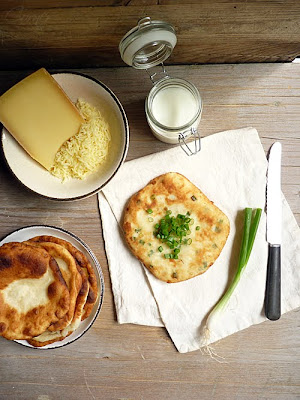
A few years ago I have already posted about the Hungarian Lángos, that is a deep fried flat bread made of a potato-based dough. Though then, I have shared a recipe without potato in the dough. However, meanwhile I enjoy the potato version a whole lot more. So it is time to post about it! It is just so different and absolutely addictive. Now, I am here with another version, that I did not like at all in my young years. Therefore, I've decided to give it another go and I must say, it was love at first bite! I am talking about my mom's favourite lángos, that is stuffed with sheep's milk quark, spring onions and fresh dill. Yummy! If you do not have the opportunity to get the mentioned quark, use goat's milk quark instead, but then add some salt to the mixture. Of course the possibilities are endless, you can stuff the dough with anything you desire, but if you enjoy sheep's and goat's milk products you should give this a try!
 Ingredients:
400 g flour
30 g fresh yeast
2 medium sized potatoes
1 tablespoon sunflower oil
5 g salt
300 ml lukewarm milk
pinch of sugar
oil for frying
300 g sheep's milk quark
bunch of dill
bunch of spring onion

For the filling mix together quark with chopped spring onion and dill. Dissolve yeast in 100 ml lukewarm milk together with a pinch of sugar and let it stand until the yeast swimms on top. Make a mold into the flour and pour the milk-yeast mixture into it. Press boiled potatoes through a strainer and stir it into the flour mixture. Knead a soft dough and add oil and salt while kneading. Sprinkle the top with flour and let it stand for 1 hour or until it doubles its size. Cut dough in equal pieces, roll out and place 1-2 tablespoons onto the middle, then cover the filling with the leftover dough from the sides and roll out the dough again. Fry the flatbreads in hot oil.
It was a wonderful snowy Friday afternoon, while I was carving for something sweet, so I decided to prepare something, that I haven't done before, and in this case haven't even eaten it until now. Yeah, strange or not, but this was the first time in my life that I have prepared this dessert and also the very first time that I ate it, though it is pretty popular. Császármorzsa or Kaiserschmarrn is one of the best known Austrian desserts, popular in the former Austria–Hungary as well as in Bavaria. In Hungary it is also known as smarni. The translation of Kaiserschmarrn has generated some etymological debate. While “Kaiser” is literally translatable (as Emperor), the same cannot be said for “Schmarrn”. “Schmarrn” has been translated as a mishmash, a mess, crumbs, a trifle, a nonsense, a fluff, or even as a mild expletive. (source:wikipedia)

Ingredients:
(recipe adapted from Johann Lafer)
200 ml milk
120 g flour
1 pinch of salt
1 tablespoon sour cream
4 egg whites
80 g sugar
4 egg yolks
2 eggs
50 g clarifed butter
15 g raisins
50 g butter
4 apples
2-3 tablespoons lemon juice
120 g sugar
40 g honey
150 ml white wine
150 ml apple juice
1 vanilla pod
1 cinnamon stick
2 star anise
zest of a half lemon

For the apple stew peel apples and cut one apple in small cubes, the rest in bigger chunks and sprinkle lemon juice on it. Caramelise sugar, add honey then pour white wine and apple juice into the pot (I have used cider instead). Add spices, lemon peel and apple and cook over medium heat until the liquid has absorbed and the apples are soft. Remove the spiced and stir in apple cubes. For the császármorzsa preheat the oven to 220°C. Whisk milk with the flour and salt until smooth, then stir in the sour cream. Beat egg whites with 30 g of sugar. Stir the eggs and the egg yólks to the milk mixutre, then fold in the beaten egg whites. Melt butter in a frying pan and pour batter into it, add raisins ( I would soak them in rum for some hours before cooking, but I haven't use any, because I do not like raisins.), cover and bake for about 15 minutes. Tear to pieces and caramelise it with 50 g sugar in the melted butter. Serve among the apple stew and with powder sugar.

Pogácsa is a typical salty scone in the Pannonian Basin and Turkish cuisine. The name derives from the Turkish word poğaça. It is a delicious example of Middle Eastern food items in Central and Eastern Europe, brought by the Turks. In Hungary it is made from either short dough or yeast dough. Today I baked some using yeast dough and juhtúró, that is a curd cheese made with sheep's milk, on top with loads of fresh Emmentaler cheese. Usually pogácsa is eaten on its own, or among a stew or gulyás. To me apples are a must with pogácsa, that is how I used to eat it during my childhood and that is the way I like it most even today.
 Ingredients:
(recipe adapted from Ottis főz)500 g flour
30 g fresh yeast100 g butter
150 g sheep's milk curd cheese
2 egg yolks + 1 for brushing
100 ml yoghurt1 teaspoon salt
200 ml milk
1 teaspoon sugar
grated cheese
Sift flour, add butter, curd cheese and salt. Heat milk until lukewarm, add sugar and yeast and set aside. As soon as the yeast swims on top pour it to the flour, add the egg yolks and knead a dough. Let it stand on room temperature for 1 and a half hours. Preheat oven to 180°C. Roll out dough about 1,5 cm thick and cut it with a round cookie cutter. Brush the tops with egg yolk and sprinkle with the cheese. Bake for about 20 minutes.

Pörkölt is a Hungarian stew made of boneless diced meat, onion, tomatoes, pepper, garlic and wine. Flavoured with majoram and the colour is given by paprika powder. Pörkölni means to roast, that is where the name of this dish comes from. The most common pörkölts are beef and pork, but of course other meats are used as well like rabbit, lamb or tripe, that version is called pacalpörkölt. Usually it is served with nokedli and pickles. If you add some sour cream you get a so called paprikás. In a paprikás the meat is cooked with the bone included, for example for a chicken paprikás you can use a whole chicken cut into pieces. Today, after all it is a Friday, I decided to serve some fish. I had the sudden idea of a fish pörkölt, that of course I served it with nokedli. I have never prepared fish pörkölt before. After reading a lot of recipes I decided to improvise. Here is my fish pörkölt with a tiny little twist.
 Ingredients:
4 fillets of zander
3 onions
1 teaspoon lard or oil
2 red bell peppers
1 yellow bell pepper
3 big tomatoes
1/4 teaspoon majoram (dried)
1 twig thyme
3 twigs dill
1/8 teaspoon paprika powder
100 ml white wine
600 ml fish stock
salt, pepper
 Chop onion, dice 1 red and half yellow pepper and 2 tomatoes. Heat lard, add chopped onion, thyme, majoram and diced pepper, stew for 5 minutes. Add white wine and let it absorb. Stir in paprika powder, diced tomato, dill, stock, salt and cook for 20-30 minutes. In the meantime, peel and dice the rest of the paprika. Heat water, cut the top and the bottom of the tomato and leave it in the boiling water for 30 seconds, remove its skin, seeds and dice. Set aside together with the diced paprika. Sieve the sauce, and bring it to cook again until it reaches the desired consistency and season with salt and pepper. Sautee paprika and tomato in white wine, season with salt and pepper. Fry fish and serve it with the sauce, nokedli and the sauteed vegetable.

When I was a child I disliked poppy. Why? Well, I made very bad experiences with it in the school canteen. Once in a while they served pasta with poppy seed as a dessert, I tried it and was totally confused: a dessert that is not sweet? Huh?! I wasn't able to eat it and that ugly taste stopped me from trying my mom's poppy pie for years. What a pity! Ever since I tried that poppy pie of hers I became a poppy addict! There is a popular Hungarian dish: the Mákos Guba and until today I didn't dare to taste it because of those childhood memories. It is usually served after a rich soup as a second course or even on Christmas' Eve. The basic recipe is to pour some sweet hot milk over bread, sprinkle with ground poppy seed and bake or cook a custard using the milk with some egg yolks and pour that over the bread. I decided to try a bit different version with loads of poppy seed. To give the whole thing a fruity touch I served some sour cherry sauce with port wein among it, that was a nice contrast to the vanilla sauce.
 Ingredients: 5 slices old bread (I used some leftover braided bread)
1 teaspoon vanilla paste
300 g poppy seed400 ml milk
4 eggs
300 g sugar
zest of 1 lemon
4-5 tablespoon powder sugarbutter for the forms
Heat milk with vanilla paste and half of the sugar. Cut bread in cubes and place them in a sieve. Pour hot milk over the bread and let it drip. Separate eggs and add yolks to the milk. Mix ground poppy seeds with powder sugar and lemon zest then sprinkle it over the milky bread cubes. Beat egg white with the leftover sugar and fold to the bread. Butter the oven proof forms and cover with ground poppy. Add bread mixture and bake for 15 minutes on 180°C. For the vanilla sauce whisk milk with the yolks over steam until it thickens.

Bukta or Buchteln are sweet dumplings made of yeast dough and filled with lekvár (=jam). Last time I ate bukta when I was 12. I bought it often in the school for breakfast. I remember, it was end of the summer holiday, so I had to get my school bag out of the locker. I had the habit that I didn't pack out my bag on the last day of school, but left it for the last day of the holiday. That way I always found a bunch of surprises, once even a half bukta. Yesterday I baked my first bukta ever, using a recipe by Johann Lafer. Mmm...I can tell you that there was no left over today morning!
 Ingredients: 60 ml milk, lukewarm
250 g flour
45 g sugar
20 g fresh yeast
2 egg yolks
2 eggs
1 pinch of saltzest of 1 orange
60 g butter, room temperature
150 g jam
30 g melted butter
Whisk milk, 30 g flour, 20 g sugar and yeast and let it raise until double its size. Add the resf ot the flour, yolks, eggs, rest of the sugar, salt, orange zest and room temperature butter. Knead a smooth dough and let it raise until double its size. Roll out dough about 1/2 cm thick and cut out circles of 6 cm diameter. Fiil each with one teaspoon of jam (i used apricot and sour cherry) and form a dumpling. Place dumplings in a buttered form and let it raise for another 30 minutes and smear melted butter over them. Bake for 30-40 minutes on 180°C.

While cleaning the freezer I found some hidden boxes of Hungarian túró, cottage cheese. I thought the best way to use is if I bake some palacsinta that I served with chilled vanilla sauce.
Ingredients:
200 g flour
2 eggs
500 ml milk
1 pinch of salt
50 ml oil
250 g cottage cheese
150 g sugar
juice of a lemon and zest
500 ml milk
2 egg yolks
50 g sugar
1 teaspoon flour
1 teaspoon vanilla extract or a vanilla pod
Whisk all ingredients together and let is stand for at least 3 to 5 hours. Oil a saucepan and bake thin palacsinta one after the other. For the filling mix cottage cheese with sugar, lemon juice and zest. Whisk egg yolks with 100 ml milk, sugar and flour. Bring the rest of the milk to boil and add to the whisked egg yolks, while stirring constantly. Put it back to the heat, but do not cook! As soon as it is thick enough, remove from the heat and chill.

Lately there is a huge boom of baking kürtöskalács in the Hungarian foodie blogsphere and that encouraged me to bake some as well. I found a great transilvanian recipe for it so therefore I had no more excuses left!
 Ingredients: 30 g fresh yeast
about 200-250 ml milk
2 tablespoon sugar
500 g flour2 eggs
2 egg yolks
1 pinch of salt
60 g butter, meltedsugar, cinnamon, walnuts for coating
 Heat 100 ml milk until lukewarm and pour it over yeast among 1 tablespoon sugar and let it stand until yeast swims on top. Add flour, rest of the sugar, eggs, egg yolks, salt and knead a dough, pouring luke warm milk in small portions into it. When the dough leaves the side of the bowl knead melted butter in it. Set dough aside to rest for an hour. Prepare kitchen paper rolls for baking: half them and cover with aluminium foil and oil. Roll out dough about 0,5 - 0,7 cm thick rectangle and slice about 2 cm thick. Roll slices up on the oiled rolls and brush with water. Roll it in cinnamon sugar or walnut sugar or whatever you desire. Bake for 10-15 minutes on 170°C.

Yesterday for the very first time I prepared my own strudel pastry. Actually it is not difficult but it is strenuous if you do it by hand. Most of the doughs I make I do not use a machine because that is just not the same. I was happy with the result for the first time: only 2 holes, well huge ones but the strudel was very delicious.
 Strudel is most often associated with the Austrian cuisine, but is also a traditional pastry in the whole area formerly belonging to the Austro-Hungarian empire.The oldest Strudel recipe is from 1696, a handwritten recipe at the Viennese City Library, Wiener Stadtbibliothek. The pastry probably has its origins in the similar Middle Eastern pastries. In Hungary we call it rétes. The traditional Strudel pastry dough is very elastic. It is made from flour with a high gluten content, egg, water and butter with no sugar added. The dough is worked vigorously, rested and than rolled out and stretched by hand very thinly. Pertaining to anecdotes, purists say, it should be so thin that a newspaper can be read through it.

The thin dough is laid out on a tea towel and the filling is spread on it. The dough with the filling on top is rolled up carefully with the help of the towel and baked in the oven. (source:wikipedia)Ingredients:250 g flour ( I used special flour for Strudel that I got from Hungary)1 teaspoon lard
3-4 dl salty, lukewarm water with a 1/4 teaspoon vinegar
2 tablespoon oil
 Crumble flour with lard and make a hole in the middle, where you pour water, but not all at once. Knead a dough, it should be smooth and elastic. Now start kneading and keep on doing it for 20 minutes, after set it aside for 15-20 minutes under a warm pot and sprinkle it with oil. Cover table with a cotton cloth and with a flour. Strech the dough and using your knuckles stretch it from the center to the sides.

Spread the filling, in my case I mixed 250 g quark with 2 tablespoons sour cream, 3 tablespoons vanilla sugar, lot of lemon peel and 1 egg yolk. Roll up pastry with the help of the table cloth. Smear an egg yolk mixed with sour cream on top of the rolled strudel and bake for 30 minutes on 180°C.

I believe there are dishes that should be prepared the way our grandmothers and their grandmothers did. I consider plum dumplings such a dish. As a child I never ate the plum, only the rest with loads of sugar. In no way I wanted to eat it with breadcrumbs, so I always asked for grated nuts or coconut, however meanwhile I am sure it is the best way to eat with the breadcrumbs! Of course it is decorative if you use white coconut flakes and black poppy seeds to coat the dumplings, but believe me, nothing can beat the original, I have tried them all! So let us stick to the tradition in this post and use the breadcrumbs. Unfortunately the plums I used are absolutely not the right ones for dumplings, but I just could not resist the thought of the juicy cinnamon and the plump potato dough sprinkled with loads of cinnamon sugar. So if you plan to prepare this dish look for the small purple plums!
Ingredients:
1 kg potato
200-300 g flour (depends how much the potato needs)
pinch of salt
1 tablespoon semolina
2 tablespoons oil
1 egg
breadcrumbs
cinnamon
sugar
small purple plums
Cook potatoes until soft. Drain and peel. Mash potatoes and add sifted flour, salt, semolina, egg, oil. Knead gently till all is blended. On a floured surface, roll dough out, not ticker than a finger.Cut dough into squares and put a with sugar and cinnamon filled plum into center of each square.Fold corners to the middle and roll the dumpling in your hands till round.Cook a few dumplings at a time in salted water for about 10 minutes until they swim on top.Place in a pan in which bread crumbs have been toasted in butter or oil.
Serve warm with cinnamon powder sugar.
Aranygaluska is a rich yeast-raised Hungarian dessert flavored with walnuts served with vanilla sauce. The yeast-raised dumplings are squished together in a baking pan, brushed with melted butter, sprinkled with grated walnut and vanilla sugar. I think it is best eaten lukewarm with ice cold vanilla sauce.
Ingredients:
For the vanilla sauce:
500 ml milk
2 egg yolk
50 g sugar
1 teaspoon flour
1 vanilla pod
For the vanilla sauce mix egg yolk with 100 ml milk, sugar and flour. Bring the rest of the milk with the vanilla pod and vanilla to boil and add to the egg yolk mixture hot. Put back to the stove and stir as long as you see it gets thick. Let it cool.
For the aranygaluska:
500 g flour
20 g fresh yeast
2 egg yolks
300 ml milk
60 g butter
50 g powder sugar
salt
200 g walnut
150 g sugar
80 g butter
Mix 100 ml lukewarm milk with 1/4 teaspoon sugar, yeast and 3 tablespoon flour. Whisk sugar with egg yolks, add milk and salt. Make a mold in the flour, add milk-yeast mixture and the egg yolk mixture. Knead a dough and knead in lukewarm, melted butter. Let it raise for an hour. Butter a baking form and sprinkle with sugar and walnut. With a help of a spoon cut small chuncks and roll in walnut-sugar. Sprinkle sugar and walnut and melted butter on each layer. Bake for 55 minutes on 160°C.


